

🎬 Title: Merry Christmas, Mr. Lawrence (戦場のメリークリスマス)
Release Year: 1983 / Director: Nagisa Oshima / Runtime: 123 min
⭐⭐⭐⭐⭐ (My Rating: 5/5)
Synopsis
Set in a Japanese POW camp in Java during World War II, Merry Christmas, Mr. Lawrence depicts the tense psychological conflict between Allied prisoners and their Japanese captors. At its center are Captain Yonoi, a strict and conflicted camp commandant, and Major Jack Celliers, a defiant British officer whose presence disrupts the fragile order of the camp. As cultural misunderstandings, unspoken desires, and codes of honor collide, the film explores power, shame, and the impossibility of true communication in wartime.
Review
Merry Christmas, Mr. Lawrence is a haunting film that lingers in the heart no matter how many years pass. Set within a wartime prison camp, it portrays the distorted and fragile relationship between Japanese captors and British prisoners. Cruelty and suffering are depicted with unsettling realism, as if the film were quietly whispering, “we are all wrong.” Every character seems possessed by some form of madness or belief.
The British prisoners are deeply troubled by the Japanese soldiers’ attitude toward death—how life is treated lightly, and even ritual suicide is aestheticized and revered. Yet the film does not stop at condemnation. In scenes where Japanese soldiers not only order others to endure severe discipline (gyō), but submit to it themselves, and in moments when a culture unfamiliar with Christmas still finds a way to honor its captives, the film reveals a form of respect that transcends nationality and position—a respect rooted simply in shared humanity.
At the center of the film stands Captain Yonoi, portrayed by Ryuichi Sakamoto. At first glance, he appears cold and inhuman, but he is gradually unsettled by Major Celliers’ unyielding spirit and unpredictable actions. Drawn toward Celliers against his will, Yonoi finds his rigid sense of order collapsing.
In the extreme conditions of war, Yonoi is torn between belief and emotion, duty and desire. The moment when he finally kisses Celliers is not merely shocking—it marks the instant he regains his humanity. It is a scene that transcends romance, becoming a moment of spiritual contact. Few scenes in film history can rival it as one of the most unforgettable “non-romantic kisses” ever captured on screen.
As Christmas approaches each year, I hope viewers remember this film—and the melody composed by Ryuichi Sakamoto. The fact that we are able to walk through our days in peace is, in itself, something we should never take for granted.
Cultural Footnotes
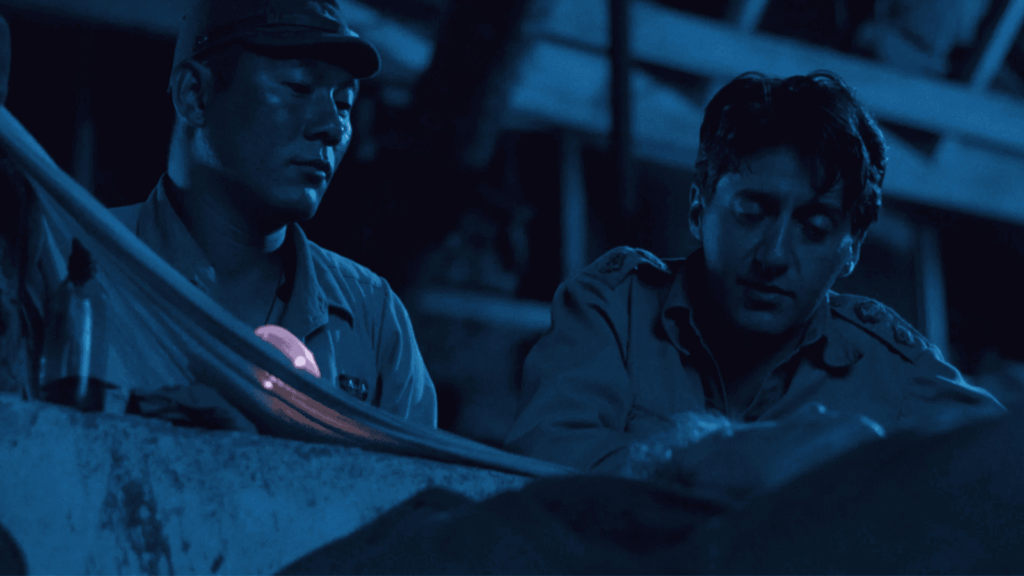
One of the film’s most fascinating aspects lies in its cast and creative context. Takeshi Kitano—now internationally recognized as one of Japan’s most influential filmmakers—appears in this film at a time when he was known primarily as a comedian. His presence captures a transitional moment in Japanese popular culture, before his later emergence as a major figure in world cinema.
The film also features Ryuichi Sakamoto, who not only plays the pivotal role of Captain Yonoi but also composed the film’s music. Sakamoto, who passed away recently, left an indelible mark on global music and cinema. The film’s main theme, “Merry Christmas, Mr. Lawrence,” has since become one of the most enduring and beloved pieces of film music worldwide, continuing to resonate across generations and cultures long after the film’s release.
Together, Kitano’s early acting appearance and Sakamoto’s dual contribution as actor and composer situate the film at a remarkable crossroads of Japanese cultural history—one that continues to echo far beyond its original moment.
Highlights
- A psychologically rich portrayal of cultural and ideological conflict
- Complex performances driven by restraint and tension
- A haunting score by Ryuichi Sakamoto that deepens the film’s emotional impact
- A bold rejection of conventional war-movie heroism
Lowlights
- Deliberate pacing may challenge viewers expecting action-driven war films
- Emotional distance can feel demanding rather than comforting
- Cultural nuances may require attentive viewing to fully grasp
Verdict
Merry Christmas, Mr. Lawrence is a singular work in the history of war cinema—intellectual, provocative, and emotionally resonant. By examining how identity, desire, and power intersect under extreme circumstances, the film continues to feel relevant decades after its release. It is not an easy film, but it is an essential one, especially for viewers interested in how cinema can confront history without simplifying it.
Credits
Director: Nagisa Oshima
Screenplay: Nagisa Oshima, Paul Mayersberg
Music: Ryuichi Sakamoto
Cast: David Bowie, Ryuichi Sakamoto, Tom Conti, Takeshi Kitano
Country: Japan / United Kingdom
Language: English, Japanese
Jilihot 777 login, let the fire burn! I am ready to hit the slots and hope the 777 smiles on me! Ready to win at jilihot 777 login
Mansionm88, time to play big or go home. Let’s get it! Hope to be able to brag with winnings. You know I’ll be here at mansionm88
Casino Plus download? You know I’m all in! Easy to grab the APK. Hope the RNG gods will be kind today. Fingers crossed! casino plus download